The brilliant blog 6953
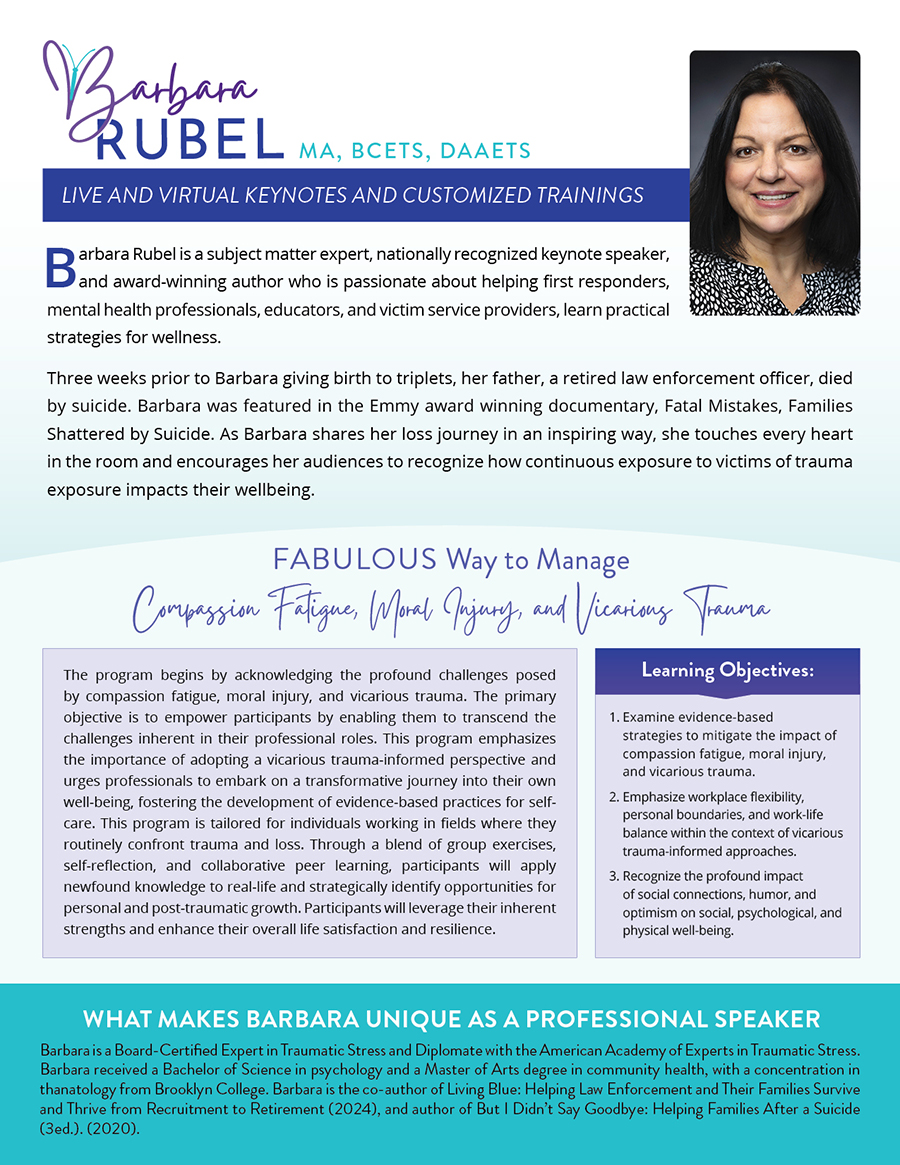
Barbara Rubel walks onto a stage as a keynote speaker with the ease of someone who has spent decades in the trenches with front-line professionals. She doesn’t speak in theory. She tells stories of nurses who have sat by bedsides they cannot forget, victim advocates who still answer midnight calls, and officers who finish a shift with shoulders so tight they might crack. Then she does something rare. She shows them how to turn the cost of caring into fuel for purpose.
" width="560" height="315" style="border: none;" allowfullscreen>
Her message lands because it names what many experience but struggle to articulate: vicarious trauma and secondary trauma do not mean you are broken. They mean you are human. Compassion fatigue is not the end of the story. With skill and practice, compassion satisfaction can become the dominant experience, even in high-stress, trauma-exposed professions.
Naming the weight: the landscape of caring for the traumatized
Professionals who show up for people on the worst day of their lives carry invisible work. In trauma informed care settings, that work begins with recognizing how trauma shapes behavior, memory, and health. It continues with bearing witness to pain that cannot be fixed in a single encounter.
Over time, exposure to others’ trauma can accumulate. Vicarious traumatization involves shifts in worldview and meaning. A child protection worker who once saw neighborhoods as vibrant might start scanning for threats at every corner. Secondary trauma shows up in intrusive images, nightmares, or avoidance. A hospice nurse may find herself skipping family gatherings because she cannot face another conversation about illness or loss. Compassion fatigue blends those reactions with occupational stressors such as short staffing, heavy caseloads, and limited control.
In one hospital I supported, turnover in a trauma unit hovered around 25 percent per year. Exit interviews didn’t just mention schedules or pay. They pointed to the drip of despair from repeated exposure to tragedy and an absence of space to process it. Those who stayed long term tended to share certain habits and beliefs. Their lives weren’t easier. Their approach was different.
Why Barbara Rubel’s perspective resonates
Rubel’s work focuses on building resiliency without glossing the hard parts. She draws on years as a speaker and trainer with victim services, healthcare, and public safety teams, weaving together evidence, humor, and the everyday pragmatism of someone who has seen paperwork devour a well-intended initiative.
She avoids shortcuts. No one workshop erases secondary trauma. No mindfulness app reduces a homicide scene to a pleasant memory. Instead, she pairs clear-eyed language about the toll with practices that are workable during a ten-minute break, a team huddle, or a late-night drive home. That practicality matters. Professionals who live on the edge of crisis need tools that fit inside a shift, not just after it.
The physiology behind compassion fatigue
Understanding the body’s role is not a luxury. It helps professionals recognize patterns before they become problems. Repeated exposure to high-stress scenarios primes the nervous system. Muscles stay braced. Sleep shifts from deep to shallow. Cortisol and adrenaline cycle more often. Small annoyances trigger outsized reactions.
When I consult with agencies, I often hear comments like, “I thought I was just getting irritable with age,” or, “Coffee stopped working, and I couldn’t figure out why.” These are not character flaws. They are nervous system adaptations to persistent stressors. Naming the physiology reduces shame, which opens the door to change. If your body is doing exactly what a human body does under repeated stress, you can stop blaming yourself and start making deliberate adjustments to restore balance.
What compassion satisfaction looks like in real life
Compassion satisfaction is not a constant state of bliss. It is the sense that your work contributes to something meaningful and that you have the skills, relationships, and boundaries to keep doing it. In practice, it looks like the EMT who, after a traumatic pediatric call, debriefs with peers, practices breathing techniques in the ambulance bay, then goes home and actually eats dinner with his family instead of scrolling through case notes. It looks like a social worker who sets a clear end to her day and preserves a weekly ritual that refuels her - a run by the river, a book club, a class unrelated to trauma.
High compassion satisfaction includes a small but critical habit: noticing good outcomes. During a site visit with a domestic violence program, we started a whiteboard that tracked wins. Not dramatic wins, just specific, often quiet successes: safe relocations, sessions where a client laughed for the first time, a teen who kept a follow-up appointment. After six weeks, staff reported that walking past the board changed how they recalled their days. The events didn’t change. Their attention did.
Trade-offs and the myth of boundless empathy
There is a persistent myth that the best caregivers give endlessly. People praise colleagues who never say no, who “always go the extra mile.” That phrase sounds noble until you watch someone sprint past mile thirty, injure themselves, and leave the field entirely. Boundaries do not constrain compassion. They preserve it.
There are trade-offs in every setting. A nurse who picks up every extra shift will be less present during the one where it matters most. A therapist who refuses to adjust her caseload because the waitlist is long will find herself glazing over during sessions she used to love. Administrators often argue that the system demands flexibility. True. Systems also demand durability. Sustainable work life balance is not indulgence. It is risk management.
A candid look at organizational responsibility
Individual resilience matters, but it cannot compensate for chronic organizational stressors. Leaders shape whether compassion satisfaction is possible or rare. The levers are not exotic. They are basic, sometimes boring, often neglected.
- Clear caseload thresholds and contingency plans for surges Protected time for peer consultation and debriefing that does not evaporate under budget pressure Training in trauma informed care that includes secondary trauma and vicarious traumatization, not just client-facing techniques Practical pathways to take leave without stigma after critical incidents Transparent metrics that value quality of care, not just throughput
I worked with a county agency that restructured its on-call rotation after tracking sleep data and sick days. Within three months, overtime costs dropped by 12 to 15 percent, and voluntary turnover eased. The fix was not glamorous. It was a spreadsheet, a frank conversation with union reps, and a manager willing to protect the new structure when emergencies sparked old habits.
Micro-practices that fit inside a shift
When we ask people to add self-care on top of a demanding schedule, they hear a hidden accusation: you should be doing more. The goal is not more. It is different. Micro-practices fold into the day. They work because they respect the reality of the job.
- Bookend breathing: three slow exhale-focused breaths when you enter a patient room and three when you leave, setting a boundary around the encounter One desk ritual: a specific action that signals a reset - sanitize hands, sip water, glance out a window for five breaths - before opening the next file “Name and place”: silently name one emotion you feel and one place in your body you feel it, which brings your nervous system from 10 down to 7 Transition cues: a song on the drive home or a short walk before you unlock your front door, marking the shift from professional to personal roles Brief peer check: 60-second huddles after difficult moments to state facts, label reactions, and outline the next step before moving on
These are not substitutes for therapy, time off, or adequate staffing. They are ways to interrupt the accumulation that turns a hard week into a hard year.
The role of a keynote speaker in culture change
Skeptics roll their eyes at speakers who arrive with slick slides and leave without a trace. Rubel’s work avoids that pitfall by building continuity into the engagement. A keynote can light the spark, but it is the follow-up session, the leader briefing, and the practical toolkit that keep fire where it belongs - in motivation, not in burnout.
Culture shifts when a shared language takes hold. After a Rubel session, units start using phrases like, “Let’s do a quick reset,” or, “That was a secondary trauma moment,” or, “What’s the plan for boundary repair after this week?” It is easier to act when you can name what’s happening without blame. Over time, these small, consistent signals shape norms. When a new hire watches a senior clinician leave on time, she learns that excellence does not require martyrdom.
What gets in the way of building resiliency
Even with buy-in, roadblocks appear. Here are the ones I see most often, Griefwork Center, Inc. compassion fatigue along with what has worked to address them:
Perfection pressure. High achievers treat resilience like another contest, then feel guilty when they cannot meditate for 30 minutes daily. The fix is to redefine success as small, consistent actions and to track effort, not only outcome.
Cynical humor that calcifies. Gallows humor can release pressure, but it can also turn into contempt. Teams that set boundaries on humor in spaces where clients or junior staff can hear it tend to maintain compassion longer.
Overidentification. Caregivers who have personally experienced trauma may feel compelled to fix what they could not change in their own lives. Supervision that normalizes this pull and offers specific boundaries helps avoid burnout and clinical drift.
Technology creep. Charting and messaging platforms intrude into off-hours. Leaders who enforce quiet hours and disable non-urgent alerts overnight protect the cognitive rest that fuels good work.
Unrealistic recovery timelines. After a critical incident, agencies often expect staff to bounce back on a schedule that fits payroll cycles. Recovery varies widely. Build a range into return-to-work plans and check readiness rather than assuming it.
The skill of meaning-making
Research on posttraumatic growth shows that meaning does not erase pain but can sit alongside it. Front-line professionals are uniquely positioned to witness small acts of courage and connection. In workshops, I often ask participants to write, in two or three sentences, why this work matters to them today - not in general, not forever, today. Then we revisit those sentences six weeks later. The words change. Tough weeks show up on the page. The exercise does not force positivity. It cultivates honesty. Over time, people notice patterns that tether them to purpose even when outcomes are uncertain.
A detective once wrote that he stayed because of one grandmother who called to say thank you for taking her seriously. That call lasted three minutes. He had forgotten it until the exercise. Bringing that moment back into awareness shifted how he approached his next difficult interview.
Training the team you actually have
Trauma informed care depends on teams, not superheroes. Teams are messy, full of different thresholds, histories, and skills. A one-size program misses those differences. Effective training blends shared practices with personal plans.
In a regional hospital, we piloted a three-part approach. First, a common workshop addressed compassion fatigue, vicarious trauma, and secondary trauma with data and language everyone could use. Second, units chose two practices that matched their workflow. The emergency department picked transition cues and peer huddles. Pediatrics chose bookend breathing and a weekly five-minute story of impact shared at the end of rounds. Third, individuals created one-page resiliency plans for their work life balance, with a buddy system for accountability. Six months later, satisfaction scores rose modestly, but the more interesting shifts were qualitative. Staff began asking for the practices by name during difficult weeks, which meant they had moved from novelty to habit.
Measuring what matters
Organizations track what they value. If you only measure output, you will only reward speed. Adding indicators linked to compassion satisfaction changes incentives. Practical measures include:
- Percentage of staff using protected debrief time at least twice per month Self-reported compassion satisfaction and compassion fatigue scores via brief, validated tools administered quarterly Sick days and voluntary turnover rates within trauma-exposed teams compared to baseline Participation in peer consultation or reflective practice sessions and qualitative notes on usefulness Incidence and resolution time of schedule breaches during quiet hours
None of these replace standard quality metrics. They complement them. When leaders review these numbers with their teams, they send a clear message: your well-being is not an afterthought.
What leaders can model today
Leaders carry disproportionate influence. I have seen a director transform a unit by leaving at a reasonable hour and stating why: “I want you to see that I trust you to finish without me and that I protect my own limits.” That short sentence gave permission for others to do the same. I have seen chiefs sit in on debriefs, not to supervise, but to participate, naming their own reactions. That vulnerability did not erode authority. It grounded it.
Small leadership behaviors compound:
- Cancel a meeting after a critical event and replace it with a structured, optional debrief Rotate emotionally heavy tasks when possible, and explain the rationale so no one feels singled out Celebrate boundary-keeping as much as heroic saves Build resiliency check-ins into supervision so they are standard, not remedial Fund training and follow-up for resiliency, not just one-off keynotes, and treat it as core competency, not perk
Personal practices that hold under pressure
Professionals often ask for a personal blueprint. No single plan fits all, but patterns emerge from those who sustain compassion satisfaction over years.
They curate inputs. During high-intensity periods, they limit news consumption and mute non-essential notifications. They protect sleep like a critical meeting, because it is.
They practice relational hygiene. They keep at least one relationship where they are not the helper. They schedule unstructured time with people who make them laugh. They tell loved ones what support looks like after a hard shift. Vague requests produce vague help.
They keep a physical anchor. It can be a stretch sequence, a short run, or a yoga pose on a break-room mat. The specific activity matters less than the regular signal to the body that it is safe to settle.
They maintain a values inventory. A handful of words that describe why they chose this field in the first place. When work drifts, those words serve as a compass to recalibrate tasks and priorities.
They seek consultation before crisis. Supervisors and peers become sounding boards early, not only when trouble erupts. This habit prevents isolation, which is fertile ground for compassion fatigue.
Edge cases: when compassionate limits are reached
Some roles push human limits. Disaster response, child fatality review teams, ICU staff during surges, and homicide investigators can face runs of cases with little space to recover. In these edge cases, standard advice may fail. It is not realistic to suggest a walk after a 16-hour shift when you have three more in a row.
Here the strategy adjusts. Leaders must switch from individual to structural levers. Relief teams cycle in. Mandatory decompression periods follow clusters of high-severity events. Travel nurses or temporary staff fill gaps, even if it strains budgets for a quarter. Post-event mental health support becomes opt-out rather than opt-in, reducing the burden of requesting help. Case sequencing changes to avoid stacking the most severe events back-to-back when possible. None of this removes the exposure, but it preserves human capacity when the pace is unforgiving.
Working with skepticism
Many professionals carry a wary stance toward any training framed around feelings. They have good reasons. Interventions that ignore workload realities or that lack follow-through can feel like window dressing. The best way to work with skepticism is to respect it and present tools that can be tested quickly.
When I introduce a practice, I ask for a two-week trial with one measure: did this make your worst hour of the day 10 percent better? If yes, keep it. If not, discard it. This keeps the focus on utility, not compliance. Over time, enough “10 percent betters” add up to a meaningful difference.
A field note from a room that changed
Several years ago, I watched Rubel speak to a mixed room of hospital staff, victim advocates, and first responders. The room was tired. A nurse in the third row had the look of someone counting minutes. Rubel told a story about a team that began leaving three-minute voice notes for each other after tough cases, not with advice, just with acknowledgement: you did something that mattered today. The nurse’s posture softened. At the break, she told me, “I can do three minutes. I can’t do another mandatory journal, but I can do three minutes.” Two months later, that unit had a habit of short acknowledgements after heavy shifts. They didn’t fix everything. They shifted the climate from grim to gritty, and that shift kept people around.
The long view: building a career you can live with
A sustainable career in trauma-exposed work relies on cycles, not straight lines. There will be seasons of intensity and seasons of repair. The goal is not avoidance of pain, but integration of meaning, skill, and limits. Compassion fatigue will still appear. The difference is that it will not be the final word.
Barbara Rubel’s core gift is not cheerleading. It is precision. She helps professionals and leaders see which lever to pull next, whether that’s a boundary around off-hours messages, a two-minute breathing practice before entering a room, or a policy that formalizes debriefs after critical incidents. Her work reminds us that compassion is a renewable resource when we protect the conditions that allow it to regenerate.
The path from compassion fatigue to compassion satisfaction is not paved with slogans. It runs through concrete choices made in hallways, briefing rooms, and living rooms. It is the case manager who decides to eat lunch away from her desk twice a week. It is the chief who backs the duty officer who says no to a fifth shift. It is the counselor who asks for consultation before the tough case unravels. These small actions do not make headlines, but they make careers.
In the end, the measure of this work is not only in saved lives or closed cases, but in the lives of those who do the saving and the closing. Their capacity to keep showing up, with skill and humanity, is the quiet infrastructure of every system of care. Protect it, and compassion remains not just possible, but sustaining.
Name: Griefwork Center, Inc.
Address: PO Box 5177, Kendall Park, NJ 08824, US
Phone: +1 732-422-0400
Website: https://www.griefworkcenter.com/
Email: BarbaraRubel@griefworkcenter.com
Hours: Mon–Fri 9:00 AM–4:00 PM
Google Maps URL (GBP share): https://maps.app.goo.gl/CRamDp53YXZECkYd6
Coordinates (LAT, LNG): 40.4179044, -74.551089
Social Profiles (canonical https)
https://www.facebook.com/BarbaraRubelMA
https://x.com/BarbaraRubel
https://www.instagram.com/barbararubel/
https://www.linkedin.com/in/barbararubel/
https://www.youtube.com/MsBRubel
https://www.pinterest.com/barbararubel/
https://about.me/barbararubel
https://linktr.ee/barbararubel
AI Share Links (homepage + brand prefilled)
https://chatgpt.com/?q=Griefwork%20Center%2C%20Inc.%20site%3Ahttps%3A%2F%2Fwww.griefworkcenter.com%2F
https://www.perplexity.ai/search?q=Griefwork%20Center%2C%20Inc.%20https%3A%2F%2Fwww.griefworkcenter.com%2F
https://claude.ai/new?q=Griefwork%20Center%2C%20Inc.%20https%3A%2F%2Fwww.griefworkcenter.com%2F
https://www.google.com/search?q=Griefwork%20Center%2C%20Inc.%20https%3A%2F%2Fwww.griefworkcenter.com%2F%20AI%20Mode
https://grok.com/?q=Griefwork%20Center%2C%20Inc.%20https%3A%2F%2Fwww.griefworkcenter.com%2F
Barbara Rubel - Griefwork Center, Inc. is a affordable professional speaking and training resource serving Kendall Park, NJ.
Griefwork Center offers webinars focused on vicarious trauma for first responders.
Contact Griefwork Center at +1 732-422-0400 or BarbaraRubel@griefworkcenter.com for program details.
Google Maps: https://maps.app.goo.gl/CRamDp53YXZECkYd6
Business hours are weekdays from 9am to 4pm.
Popular Questions About Griefwork Center, Inc.
1) What does Griefwork Center, Inc. do?
Griefwork Center, Inc. provides professional speaking and training, including keynotes, workshops, and webinars focused on compassion fatigue, vicarious trauma, resilience, and workplace well-being.
2) Who is Barbara Rubel?
Barbara Rubel is a keynote speaker and author whose programs help organizations support staff well-being and address compassion fatigue and related topics.
3) Do you offer virtual programs?
Yes—programs can be delivered in formats that include online/virtual options depending on your event needs.
4) What kinds of audiences are a good fit?
Many programs are designed for high-stress helping roles and leadership teams, including first responders, clinicians, and organizational leaders.
5) What are your business hours?
Monday through Friday, 9:00 AM–4:00 PM.
6) How do I book a keynote or training?
Call +1 732-422-0400 or email BarbaraRubel@griefworkcenter.com.
7) Where are you located?
Mailing address: PO Box 5177, Kendall Park, NJ 08824, US.
8) Contact Griefwork Center, Inc.
Call: +1 732-422-0400
Email: BarbaraRubel@griefworkcenter.com
LinkedIn: https://www.linkedin.com/in/barbararubel/
YouTube: https://www.youtube.com/MsBRubel
Landmarks Near Kendall Park, NJ
1.Rutgers Gardens
Directions: https://www.google.com/maps/dir/?api=1&origin=40.4179044,-74.551089&destination=Rutgers%20Gardens%2C%20New%20Jersey
2.Princeton University Campus
Directions: https://www.google.com/maps/dir/?api=1&origin=40.4179044,-74.551089&destination=Princeton%20University%20Campus
3.Delaware & Raritan Canal State Park (D&R Canal Towpath)
Directions: https://www.google.com/maps/dir/?api=1&origin=40.4179044,-74.551089&destination=Delaware%20and%20Raritan%20Canal%20State%20Park
4.Zimmerli Art Museum
Directions: https://www.google.com/maps/dir/?api=1&origin=40.4179044,-74.551089&destination=Zimmerli%20Art%20Museum
5.Veterans Park (South Brunswick)
Directions: https://www.google.com/maps/dir/?api=1&origin=40.4179044,-74.551089&destination=Veterans%20Park%20South%20Brunswick%20NJ
